
A PrestaShop Mobile App can create a very different conversion environment than a mobile browser. The 3x “higher conversion rates” cannot be taken for granted for every merchant, but the latest research within one brand revealed a considerable difference: Poq identified a median app conversion rate 1.8 times higher than mobile web in 21 retailers, with some brands having even 4x higher rates.
That distinction matters. Your mobile website still works for discovery, search traffic, first-time visitors, and customers who do not wish to install any applications. Your app appeals to another category of customers: those who have enough familiarity with your store to keep it on their phone.
For a PrestaShop merchant, the real opportunity is not replacing the website. It is creating a stronger purchase path for high-intent customers through a PrestaShop Mobile App. And that’s where the mobile app for your PrestaShop store comes in; a dedicated Mobile App for PrestaShop gives those customers a faster, more direct route back to purchase.
Why app conversion can be substantially higher
An app starts with a built-in advantage that a browser visit doesn’t have: the customer has already taken an action to keep your store accessible.
That changes the quality of the audience. People who install the shopping app are generally more involved with the brand compared to those who come to a product page by searching on Google, via advertising, social media, or comparison.
While it is true that people using the app convert, spend more money per visit, and make larger orders, it is also partly because they come from another audience.
This is why a store shouldn’t look at an app’s conversion rate in isolation. Compare app customers with your own mobile-web customers, using the same product mix and a comparable period wherever possible.
The useful metric is your incremental commercial value, not somebody else’s headline percentage.
A simple example
Let us say you get 100,000 visits per month to your mobile website and have a 2% conversion rate, which leads to 2,000 orders placed.
Imagine now that 10,000 existing customers start using your app and your app has a 5% conversion rate. That produces 500 orders from a much smaller audience.
The app hasn’t replaced your website. It has created a higher-performing channel for a specific segment of customers.
Your actual numbers may look very different, but the model illustrates why app adoption doesn’t have to reach every mobile visitor to become commercially relevant.
The 3x claim needs some context
Calling apps “3x higher converting” is tempting because it gives merchants a simple benchmark. The problem is that conversion studies don’t produce one universal number.
Poq’s 2026 analysis reports a 1.8x median advantage for apps across 21 retailers with comparable app and mobile-web data. All measured merchants in that sample converted better in-app, while the strongest performers exceeded 4x.
MobiLoud also highlights substantial app advantages but warns against combining figures from unrelated datasets because industries, audiences, time periods, and measurement methods differ.
So, for a PrestaShop merchant, the sensible interpretation is this:
A well-designed app can materially outperform mobile web among engaged customers, but 3x should be treated as a potential benchmark, not a promise.
Then, a two-fold increase in your conversion rate is significant even though it does not go up threefold. In case your conversion rate increases by 1.1, the natural follow-up question would be “Why not?”
What changes inside the shopping journey
A mobile browser makes customers repeatedly solve small problems.
They may need to search for the store again, sign in, navigate a dense menu, enter information, wait for pages to load, or return to a product they previously viewed.
A dedicated app can reduce some of that repeated friction.
Your mobile experience should make key activities easily accessible to the customer. They should be able to move between categories, products, wish lists, shopping cart, and account pages without each visit being counted as a new session.
This applies to PrestaShop stores, especially if your business is built on repeated purchases. Fashion, cosmetics, grocery, accessories, hobby products, and replenishment-driven categories can all benefit from making the second and tenth purchase easier than the first.
The goal isn’t to make the app look impressive. The goal is to make returning customers spend less effort getting back to what they already wanted.
Where a PrestaShop Mobile App can make the biggest difference
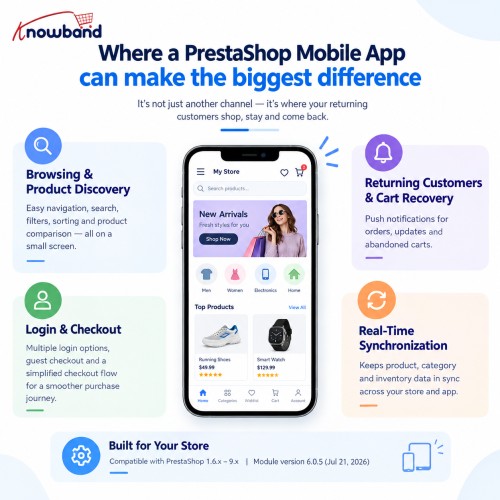
The strongest opportunity usually appears after the customer already knows your brand. A Mobile App for PrestaShop is built for that returning audience, not for the first-time discovery visit.
A browser is excellent for bringing someone in. An app can become the more convenient place to come back.
Browsing and product discovery
A useful app should make the product catalog easy to navigate on a small screen.
PrestaShop Mobile App Builder includes support for navigation of categories, product searching, filtering, sorting, and listing in either grid or list mode. In addition, the app gives users access to product pages, the ability to add products to wishlists, and the option to add products to the cart.
It is necessary because browsing is more typical for mobile users than searching for specific products. A customer looking for “something new” needs an interface that makes comparison easy without burying the important controls.
Login and checkout
Every unnecessary field creates another opportunity for a shopper to leave.
The module documentation describes multiple login methods, including email, phone-number OTP, social login, and fingerprint authentication. It also supports guest checkout, according to the supplied product requirements, while the manual documents a simplified checkout flow covering shipping, billing, order review, and payment.
A shorter checkout doesn’t automatically produce more orders. Payment methods’ compatibility, security concerns, delivery costs, stock information, and whether the products are suitable for your market all matter.
Still, reducing unnecessary navigation is worth testing.
Returning customers and cart recovery
Browser shoppers can abandon a cart and simply disappear.
An app gives a merchant another communication channel. The documented builder supports push notifications for order creation, order-status changes, and abandoned carts.
That creates a practical abandoned cart recovery workflow. A customer who left products in a cart can receive a reminder without having to reopen an email or remember the store’s URL.
The timing deserves care. Sending too many messages can train customers to ignore them, while a relevant reminder tied to genuine shopping intent can be useful.
The technical reason synchronization matters
Data synchronization issues quickly make a shopping app frustrating.
For example, a user views an item as being available within the app, adds it to the cart, and then finds out the web store has different stock levels. Or a promotion shows up on one medium but not the other.
From the document given, it follows that the mobile app is able to perform the function of synchronization of product and category data as well as inventory data in real time between the PrestaShop store and the mobile app.
The current product page demonstrates that the module is compatible with PrestaShop store versions from 1.6.x to 9.x and shows that the currently released module version is 6.0.5, released on July 21, 2026. It’s important to note that store owners should check compatibility with their particular installation and custom modules before deployment.
It is more important than you might think because a highly customized version of PrestaShop requires testing on payment gateways, shipping settings, customizations, customer validation process, and other third-party add-ons.
Mobile commerce is not just about conversion rate
The reason why conversion is being focused on is quite obvious since it is easy to measure; however, it is not the only valuable KPI.
An app can influence how frequently existing customers return, how deeply they browse, and how much revenue an active user generates over time.
According to Poq’s recent data set, app users generated 1.5 times more income per session on median, and 80% of the retailers analyzed from their 21-brand sample had a higher average order value.
It does not imply that you will have similar results. They do suggest that measuring only app installs would miss the commercial question.
Track the journey instead:
- app install to first purchase
- repeat purchase frequency
- app versus mobile-web conversion
- average order value
- cart recovery
- revenue per active app customer
- notification engagement
This gives an eCommerce manager a much clearer picture of whether the channel is earning its place.
Don’t neglect the mobile website
A common strategic mistake is treating an app as permission to stop improving the website.
That would be backwards.
The fact that PrestaShop describes its storefront as responsive means that its webstore can adjust to any display size. Your mobile site remains the most convenient way for a user to enter the store after discovering a product via a search engine or sharing link.
The app and website should have different jobs.
Use the web experience to capture broad demand and make the brand discoverable. Use the app to deepen the relationship with customers who already have a reason to return.
That division also changes how you evaluate acquisition campaigns. The person visiting a product page through an ad is supposed to be evaluated differently from the person receiving push notifications because they bought three times before.
How to decide whether your store is ready
An app makes more sense when your store already has signs of repeat customer behavior.
Look at your analytics before investing.
If customers frequently return, browse several products per visit, abandon carts, or purchase repeatedly from the same categories, an app can give those customers a more persistent shopping channel.
If you have many one-off visitors coming to your store but few returning ones, start with product-market fit, mobile performance, merchandising, acquisition quality, and checkout experience.
It’s equally true about catalog size. If your store has only 50 selected items, it probably needs a completely different home screen design compared to a store with 50,000 SKUs.
A PrestaShop eCommerce Mobile App should reflect those differences rather than just put all of the web elements into a smaller window.
What the PrestaShop Mobile App Builder actually provides
The current product documentation talks about an Android and iOS mobile application built using Flutter technology, where store information is synchronized between PrestaShop and the mobile app. In addition, the product page mentions various home screen layouts, several ways to log in to the app, multilingual and right-to-left language support, several payment options and delivery methods, order tracking, WhatsApp chat, and push notifications.
The user manual provides additional controls for the mentioned functionality.
Knowband’s approach is particularly relevant for merchants who want an app without building the Android and iOS applications from scratch. The documentation describes the solution as a Flutter framework and explains a process based around installing the module, sharing app requirements, and receiving the generated application files.
Knowband also lists current compatibility through PrestaShop 9.x, but merchants should test their own store’s customizations before treating compatibility on paper as proof that every third-party module will behave identically inside the app.
Common mistakes that can erase the advantage
A technically functional app can still perform poorly.
Users need to get some benefits from using the app, such as ease of repeat purchases, notifications, better browsing experience, preference settings, or account management.
Another bad move could be sending notifications too often. Notifications should be justified and be respectful of customer preferences.
A third issue is copying the desktop website’s information architecture without considering the phone screen. An app needs deliberate prioritization. The most commercially important categories and products should not compete with every available navigation option.
Last but not least, do not pay too much attention to the app download numbers. An app having 20,000 downloads without any activity might be worth less than some other app with 3,000 loyal buyers.
A practical 2026 measurement plan
Prior to the release, make sure you measure your mobile-web benchmark for an appropriate amount of time.
Conversion rates, AOV, repeat purchase, checkout conversion, cart abandonments- these are just some things to measure. Once the app is live, compare the performance of your app users to an appropriate mobile-web segment, not the traffic overall, before and after the app launch.
Give enough time for accumulating the active user base. Then analyze whether your app users purchase more often, convert at a higher rate, recover their abandoned carts better, or make them spend more money per active user.
This approach also protects you from a misleading “3x” target. If your app reaches 2x conversion while becoming a meaningful repeat-purchase channel, the business result may still be excellent.
The bigger opportunity for PrestaShop merchants
The strongest argument for an app isn’t that browsers are obsolete. They aren’t.
The argument is that mobile shoppers aren’t one homogeneous audience. A first-time visitor discovering your store through Google has a different level of intent from a customer who has already bought three times and wants to reorder from the phone.
A dedicated PrestaShop Mobile App gives you another surface for the second customer. Think of it as a PrestaShop eCommerce Mobile App made for your loyal customers.
For store owners, it is the wrong question to ask whether the app will help to convert three times better. Instead, it is necessary to think about which customers will become more valuable if returning to your store takes one tap instead of another browser session.
That is a question your own analytics can answer.
A PrestaShop Mobile App Maker can reduce the technical work of building that channel, but the commercial strategy still belongs to the merchant. The app needs useful merchandising, sensible notifications, reliable store synchronization, and a checkout experience that earns the customer’s trust.
Knowband’s PrestaShop Mobile App Builder is one option worth evaluating if those requirements match your store.
The most practical thing to do next would be to benchmark how well you’re doing with mobile web and how the actions of your returning customers compare. If there is a significant percentage of returning users, a PrestaShop Mobile App can be used to convert and retain users. Review the PrestaShop Mobile App Maker and its documented capabilities before deciding whether it fits your store’s requirements.


